Westlake Village, CA, March 18, 2026 (GLOBE NEWSWIRE) -- Editor's Note: The phrases "effective anti-snoring oral solution" and "clinically proven ingredients" in the headline reflect terminology used within SnoreStop® brand materials from Green Pharmaceuticals Inc. These descriptions have not been independently evaluated by this publication and are presented here strictly in the context of the company's own published product descriptions. This report is presented as a source-based informational overview referencing publicly available company materials and should not be interpreted as an independent product review or clinical evaluation.
The following informational overview is based on available materials from Green Pharmaceuticals Inc., including official product descriptions, policy pages, and cited research references relating to SnoreStop® Throat Spray. This overview is intended solely to summarize available information for consumer awareness. This article contains affiliate links. If a purchase is made through these links, a commission may be earned at no additional cost to the buyer. This content is not intended as medical, health, or dietary advice. All product details described below are stated as presented by the company and should be verified directly on the official website before any purchasing decision.
In this report, references to effectiveness, ingredient validation, or performance reflect how SnoreStop and its manufacturer, Green Pharmaceuticals Inc., describe the product based on materials available on the company's website and cited research references. These terms do not indicate an independent editorial finding by this publication and should not be interpreted as independently verified clinical outcomes. Consumers are encouraged to review the original company-provided information and cited research for full context.
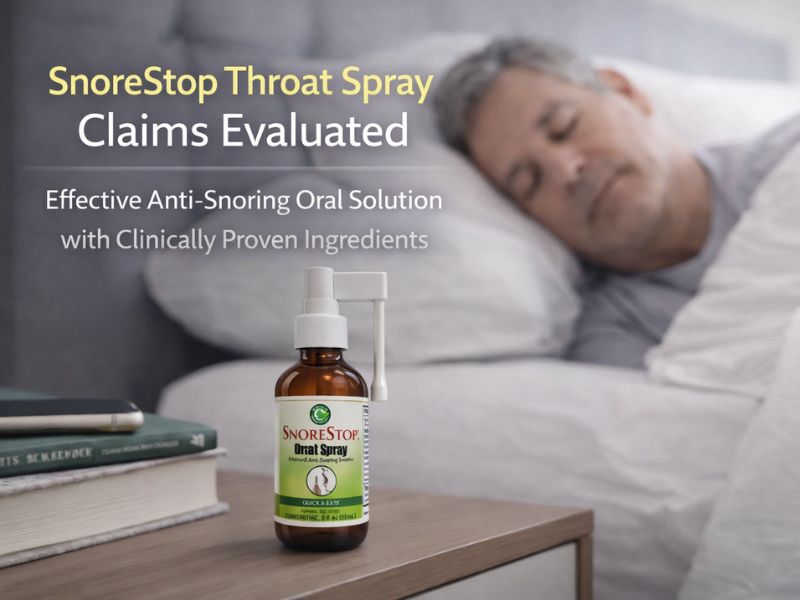
If you share a bed with someone — or if you're the someone — snoring has probably disrupted more than a few nights. Maybe you've tried the nasal strips that peel off by 2 a.m., the mouth tape your partner refuses to wear, or one of those mouthguards that ends up on the nightstand by morning. You're researching solutions because the problem is real, and most of what you've tried hasn't stuck.
SnoreStop is a homeopathic oral spray that has been on the market since 1995, developed by Dr. Kenneth Rifkin, a naturopathic physician. The product is manufactured by Green Pharmaceuticals Inc. and distributed through a partnership with GiddyUp, described on the company's website as a curator of innovative products. With what the company describes as over 3 million customers served across three decades, SnoreStop is among the longest-running over-the-counter anti-snoring products in the United States — and among products in this category that reference a published clinical study.
This overview does not recommend for or against SnoreStop. Instead, it outlines how the company describes the product based on publicly available information, what the cited research shows under controlled study conditions, how the homeopathic framework applies, and where consumers should do their own verification before purchasing.
Current product details, pricing, and terms can be confirmed by viewing the current SnoreStop offer (official SnoreStop page).
Individual results vary. Snoring can be influenced by multiple health, lifestyle, and anatomical factors. This product is not a substitute for professional medical evaluation. Consult a qualified healthcare provider before starting any new health product, particularly if you have symptoms that may indicate a more serious condition such as sleep apnea.
What Is SnoreStop
SnoreStop is a homeopathic oral spray designed to temporarily relieve symptoms of non-apneic snoring, as stated on its product labeling. It is classified as a Human OTC Drug under the homeopathic framework and is listed on the FDA's DailyMed database under NDC 61152-400, with a marketing category of "unapproved homeopathic." The product is prepared in accordance with the Homeopathic Pharmacopoeia of the United States (HPUS).
An important distinction for consumers: SnoreStop is registered with the FDA as a homeopathic product manufactured in what the company describes as GMP-certified facilities. FDA registration relates to manufacturing facility compliance and does not constitute FDA approval, endorsement, or evaluation of the product's claimed effectiveness. As listed on the FDA's DailyMed database, the product includes the following disclaimer: it has not been evaluated by the Food and Drug Administration for safety or efficacy, and the FDA is not aware of scientific evidence to support homeopathy as effective.
According to the product page, the company positions SnoreStop as a device-free, non-invasive alternative to mouthguards, nasal inserts, and mouth tape. The spray is described as being used at bedtime — a few sprays under the tongue and in the back of the throat — with the goal of addressing factors the company associates with snoring in the throat area.
Green Pharmaceuticals Inc. is headquartered in Westlake Village, California. According to publicly available product packaging and label records, the spray is manufactured by Homeocare Laboratories and labeled and packaged by Green Pharmaceuticals Inc. The product has been available in the United States since the late 1990s, and the company describes a 30-year history of consumer use.
Clinical Study Referenced in Company Materials: What Consumers Can Verify
One of SnoreStop's distinguishing characteristics, as referenced in company materials, is a published, peer-reviewed clinical study. The company describes this as a randomized, double-blind, placebo-controlled independent clinical study reporting that 79.5% of participants experienced noticeable improvements within the first five nights of use.
This study is verifiable through public databases. It was published in the peer-reviewed journal Sleep and Breathing (Volume 3, Number 2, 1999). The full title is "A Randomized Double-Blind Placebo-Controlled Evaluation of the Safety and Efficacy of a Natural Over-The-Counter (OTC) Medication in the Management of Snoring." The study authors were Derek Lipman of the Division of Otolaryngology at Emanuel Hospital in Portland, Oregon, along with Gary Sexton and Jerry Schlesser. It is indexed on PubMed under PMID 11898106.
According to the PubMed abstract, the study reports that the treatment was statistically more effective than placebo and that neither side effects nor intolerance to the product were reported within the study sample.
This study is one of the research references cited in the company's materials. Many over-the-counter anti-snoring products on the market do not reference any published clinical data. Having a randomized, placebo-controlled study published in a peer-reviewed journal, as cited in company materials, distinguishes SnoreStop from many products in this category.
That said, consumers reviewing this cited study should consider several contextual factors. The study was published in 1999 and involved what the company describes as 100 participants. The lead author, Dr. Derek Lipman, is also listed on SnoreStop's current website as one of the product's endorsing physicians. Consumers interested in reviewing the study's independence, methodology, sample demographics, and specific measured endpoints can access the publication through PubMed or the Springer database using the DOI reference.
The 79.5% figure cited by the company refers to the proportion of participants who reported noticeable improvement, as referenced in company materials. It is important to distinguish between reported subjective improvement and the specific clinical endpoints used to measure that improvement, which consumers can review in the full publication.
The company also references endorsements from several physicians on the product website, including Dr. Kenneth Rifkin (the product's developer), Dr. Derek S. Lipman (ENT and Otolaryngologist, also a study author), and Dr. Peter Fisher (described as Director of Research at the Royal London Hospital). These endorsements are stated as presented on the company's website and have not been independently verified by this publication.
How Homeopathic Products Work: What the Regulatory Framework Means for Consumers
SnoreStop is formulated under the Homeopathic Pharmacopoeia of the United States (HPUS), which is the regulatory framework governing homeopathic products in the United States. Understanding what this means helps consumers set appropriate expectations.
Homeopathic products use naturally derived substances prepared through a process of serial dilution. The dilution levels are indicated by designations such as 6x, 12x, and 30x, where higher numbers indicate greater dilution. As listed on the product label, SnoreStop's active ingredients are prepared at dilutions including 4x, 6x, and 12x potencies.
Homeopathic products are regulated differently from both dietary supplements and conventional pharmaceutical drugs. They are not required to undergo FDA premarket approval, and the FDA has stated that it is not aware of scientific evidence supporting homeopathy as effective. However, homeopathic products are legal to sell in the United States when manufactured in compliance with HPUS standards and applicable FDA regulations.
According to the product's official labeling, the company states that all ingredients are recognized as GRAS (Generally Recognized As Safe) and are part of an official collection of accepted drug ingredients under the Federal Food, Drug and Cosmetic Act. As referenced on the product label, SnoreStop contains no measurable amount of alkaloids, ephedrine, or pseudo-ephedrine.
This is relevant because two of the product's listed active ingredients — Belladonna and Ephedra vulgaris — have regulatory histories that informed consumers may research. The FDA issued advisories about belladonna in certain homeopathic products marketed for infants in 2016 and 2017, and the FDA restricted concentrated ephedra extract in dietary supplements in 2004 due to cardiovascular risks. In both cases, the concerns related to products with different concentration levels and different target populations than SnoreStop's adult-use homeopathic dilutions. Consumers with questions about the inclusion of these ingredients at homeopathic dilution levels should consult their healthcare provider.
SnoreStop Active Ingredients: What the Label Discloses
As shown on the product label, the SnoreStop Throat Spray lists seven active homeopathic ingredients, each with the company's stated purpose:
Nux vomica (4x, 6x): According to the company, included to help open a constricted pharynx.
Teucrium marum (6x): According to the company, included to help open air passages.
Belladonna (6x): According to the company, included to help decongest enlarged tonsils.
Hydrastis canadensis / Goldenseal (6x): According to the company, included to help decongest a swollen tongue.
Ephedra vulgaris (6x): According to the company, included to help relieve congestion.
Kali bichromicum / Potassium Dichromate (6x): According to the company, included to help relieve a stuffy nose.
Histaminum hydrochloricum (12x): According to the company, included to help relieve allergy symptoms.
Inactive Ingredients: Alcohol (100 micro centiliters per spray), Glycerin, Potassium sorbate, Purified water (75%), as listed on the product label.
These ingredient purposes are drawn from authorized homeopathic Materia Medica references, as stated on the product's official labeling. They represent the traditional homeopathic rationale for inclusion and should not be interpreted as independently verified therapeutic claims for the finished product.
How the Company Positions SnoreStop Against Alternatives
According to the product website, the company's marketing compares SnoreStop against two primary alternatives: mouthpieces and mouth tape. The brand describes SnoreStop as what the company calls a natural, over-the-counter, device-free solution that targets snoring where it starts — in the mouth and the back of the throat.
As shown on the product page, the company's comparison chart emphasizes several attributes: that the spray targets internal throat airways rather than external airflow, requires no maintenance or cleaning, works in any sleeping position, and uses what the company describes as a natural formula. The portability factor is also highlighted — the spray is small enough to fit in a toiletry case, which the company positions as an advantage for travelers.
Consumers reviewing these comparisons should note that the company is describing its own product positioning. Independent head-to-head studies comparing SnoreStop to mouthguards, mandibular advancement devices, or other anti-snoring products haven't been referenced in the company's materials. The comparison represents the brand's marketing framework, not independently verified competitive analysis.
Consumer Use-Case Considerations Based on Company Positioning
Based on how the product is described in company materials, consumers may consider whether the following factors are relevant to their own needs.
SnoreStop may align well with people who:
Prefer a device-free approach: If mouthguards, nasal strips, or CPAP-adjacent devices haven't been comfortable or practical for you, a spray-based approach offers a fundamentally different experience. As described on the product page, SnoreStop requires no fitting, no cleaning, and no adjustment period for jaw or mouth positioning.
Are open to the homeopathic framework: SnoreStop is formulated under HPUS standards using homeopathic dilutions of naturally derived ingredients. If you are comfortable with homeopathic products and understand the regulatory framework they operate under, this product aligns with that health philosophy.
Travel frequently or share sleeping spaces: According to the company, the spray's compact size and silent application make it practical for hotel stays, shared rooms, or situations where wearing a device would be inconvenient or uncomfortable.
Want a product with a long market history: With what the company describes as 30 years on the market and over 3 million customers, SnoreStop has a track record that many newer products can't match. The published clinical study cited in company materials adds a layer of formal research that is uncommon in this category.
Other options may be preferable for people who:
Have been diagnosed with or suspect sleep apnea: The company states explicitly that SnoreStop is designed for simple, non-apneic snoring and is not intended to treat sleep apnea. As referenced in the company's FAQ, the product page advises: "If you experience gasping, pauses in breathing, or wake yourself up from sleep, please consult a healthcare professional." This is a serious medical condition requiring professional evaluation.
Prefer products with full-disclosure ingredient dosing: Because homeopathic preparations use dilution designations (6x, 12x, etc.) rather than milligram-based dosing, consumers who prefer to compare specific active compound amounts against published research may find the labeling framework less transparent than conventional supplement labels.
Have concerns about specific homeopathic ingredients: If you have questions about the inclusion of Belladonna or Ephedra vulgaris at any dilution level, consult your healthcare provider before using this product.
SnoreStop Pricing and Purchase Structure
According to publicly available information, SnoreStop Anti-Snoring Throat Spray is available through multiple channels. The company's official website (snorestop.com) lists the throat spray at a regular price of $24.99 per bottle, as shown on the product page. The current promotional offer page — presented through the company's partnership with GiddyUp — advertises a "Save 40%" promotion, though specific discounted pricing per bottle and available bundle options should be verified directly on the offer page, as promotional terms can change.
According to the company's FAQ, one bottle of oral spray contains approximately 60 applications. Using it nightly as directed, one bottle is described as lasting about 30 days.
The product is also available through third-party retailers including Amazon and Walmart, though the company's promotional offer page advises consumers to purchase directly through their site rather than third-party retailers to support the product's inventors.
Consumers should verify current pricing, bundle options, and shipping terms before purchasing. Complete product details and current offers are available by viewing the current SnoreStop offer (official SnoreStop page).
SnoreStop Refund Policy and 30-Day Guarantee
According to the company's published terms, SnoreStop offers a 30-day money-back guarantee. Per the published return policy, consumers who are unsatisfied can contact the company via email with their Order Number to initiate a return.
Several details are worth noting before purchasing. According to the company's published policy, order shipping costs are non-refundable. The policy states that after the shipping department receives a return, it generally takes ten business days to process a refund, with an additional period of up to ten days for the credit to post to the consumer's account depending on their financial institution.
The company's terms also note that all sales are final from order fulfillment in accordance with the refund policy. Consumers who wish to cancel an order before shipment can attempt to do so by contacting the support email, though the company states it can't guarantee cancellation if the request arrives near the time of shipment.
Consumers are encouraged to review the complete refund and cancellation terms on the official website before ordering, and to retain all purchase confirmation details.
SnoreStop Satisfaction Claims: What Consumers Should Know
The company's promotional materials reference a "95% satisfaction rate" and describe "3,000,000+ happy customers," as shown on the promotional offer page. These figures represent the company's marketing claims.
The company's Terms of Service include a relevant disclosure: as referenced in the company's published terms, testimonials submitted to the company "do not represent the generally expected user experience." This is an important distinction between marketing presentation and what any individual consumer should expect.
As with any consumer product, people who voluntarily leave reviews or provide feedback tend to be self-selected — those with particularly strong positive or negative experiences are more likely to share their perspectives than those with moderate or neutral results. This self-selection dynamic applies broadly across consumer products and should be factored into how satisfaction claims are interpreted.
Consumers researching terms such as "SnoreStop reviews," "does SnoreStop work," or "SnoreStop legit" should consider satisfaction claims in this context and keep in mind that individual results depend on numerous personal factors including the specific cause and severity of snoring, sleeping position, alcohol consumption, nasal congestion, and underlying health conditions.
Consumer Verification Checklist: What to Confirm Before Ordering
Understand the product's regulatory classification. SnoreStop is a homeopathic product, not a dietary supplement and not an FDA-approved drug. As listed on the FDA's DailyMed database, the product includes a disclaimer that it has not been evaluated for safety or efficacy. Understanding what "FDA-registered" means versus "FDA-approved" helps set accurate expectations.
Review the published clinical study cited in company materials. The 1999 study in Sleep and Breathing is indexed on PubMed (PMID: 11898106) and available through Springer. Reviewing the full publication — including methodology, sample size, measured endpoints, and author affiliations — provides a more complete picture than the 79.5% figure alone.
Know the difference between non-apneic snoring and sleep apnea. As stated on the product label, SnoreStop is designed for simple snoring only. If you experience gasping during sleep, pauses in breathing, excessive daytime sleepiness, or if your partner observes you stopping breathing during the night, consult a healthcare professional before using any over-the-counter snoring product.
Confirm refund terms independently. Review the 30-day guarantee terms, non-refundable shipping costs, and processing timelines directly on the official website before purchasing.
Consult your healthcare provider. This is particularly important if you take medications, have existing health conditions, are pregnant or breastfeeding, or have any symptoms that might indicate obstructive sleep apnea. A healthcare provider can help determine whether an over-the-counter snoring product is appropriate for your situation or whether further evaluation is needed.
Consumer Questions About SnoreStop
What is SnoreStop?
According to company materials, SnoreStop is a homeopathic oral spray developed by Dr. Kenneth Rifkin in 1995 and manufactured by Green Pharmaceuticals Inc. It is described as temporarily relieving symptoms of non-apneic snoring through a formula containing seven active homeopathic ingredients prepared under HPUS standards. The product is classified as a Human OTC Drug under the homeopathic regulatory framework.
Is SnoreStop FDA approved?
SnoreStop is not FDA-approved. It is registered with the FDA as a homeopathic product and manufactured in what the company describes as FDA-registered, GMP-certified facilities. FDA registration means the manufacturing facility has registered with the FDA as required by federal law and is subject to FDA inspection. It does not mean the FDA has reviewed, approved, or endorsed the product or its effectiveness. As listed on DailyMed, the product includes a disclaimer stating that this homeopathic product has not been evaluated by the FDA for safety or efficacy.
What does "clinically proven" mean in this context?
The company references a randomized, double-blind, placebo-controlled study published in Sleep and Breathing in 1999 that reported 79.5% of participants experienced noticeable improvements. As used in the company's marketing, the phrase "clinically proven" refers to ingredients the company describes as supported by this specific cited study. The study is a single published trial from 1999. Consumers should review the study's scope, sample size, and methodology when interpreting this reference.
Will SnoreStop help with sleep apnea?
No. The company states explicitly that SnoreStop is designed for simple, non-apneic snoring and is not intended to treat sleep apnea. As listed on the product's FDA label, the labeling states "DOES NOT TREAT SLEEP APNEA" in capitalized text. Sleep apnea is a serious medical condition requiring professional care. As referenced in the company's FAQ, if you experience symptoms such as gasping, breathing pauses during sleep, or excessive daytime sleepiness, the company recommends consulting a healthcare professional.
How quickly does SnoreStop work?
According to the company's FAQ, most people notice quieter sleep the first night. For maximum effectiveness, the company recommends consistent use for five nights. As stated on the product label, consumers should allow three to five days for initial treatment. Some people may see results sooner, while others may need several nights for the formula to take full effect. Individual timelines vary.
Is SnoreStop safe for nightly use?
According to the company, the product is formulated with natural, homeopathic ingredients that are GRAS-certified and non-habit forming. As listed on the product label, standard warnings include: use only as directed, keep out of reach of children, and if pregnant or breastfeeding, ask a doctor before use. The label also advises consumers to stop use and ask a doctor if symptoms do not improve in seven days.
Does SnoreStop contain alcohol?
Yes. As listed on the product label, inactive ingredients include Alcohol (100 micro centiliters per spray), along with Glycerin, Potassium sorbate, and Purified water (75%). Consumers who avoid alcohol-containing products should note this before use.
Where can I buy SnoreStop?
According to company materials, SnoreStop is available through the official website (snorestop.com), the promotional offer page through the GiddyUp partnership, and through third-party retailers including Amazon and Walmart. The promotional offer page notes that purchasing directly supports the inventors of the product. Consumers should verify authenticity and refund eligibility when purchasing through any channel. Current details are available by viewing the current SnoreStop offer (official SnoreStop page).
Summary of Key Considerations
Based on publicly available materials, SnoreStop is a homeopathic oral spray with a 30-year market history and among anti-snoring products in this category that reference a published, peer-reviewed clinical study. As cited in company materials, the 1999 study in Sleep and Breathing reported that the treatment was statistically more effective than placebo, with 79.5% of participants reporting improvement and no side effects reported within the study sample.
At the same time, the product operates under the homeopathic regulatory framework, and the FDA's DailyMed listing includes a disclaimer that the product has not been evaluated for safety or efficacy. The clinical study referenced in company materials is a single trial from 1999, and the lead author is also listed on the company's website as one of the product's endorsing physicians. These are factors consumers should weigh alongside the study's reported findings.
The product is explicitly not intended for sleep apnea — a critical distinction that the company itself emphasizes across its product labeling and FAQ. Anyone with symptoms suggesting sleep apnea should pursue professional medical evaluation rather than over-the-counter solutions.
Consumers who have completed their own research and want to review the full product details, current pricing, and published terms can do so. Complete information is available by viewing the current SnoreStop offer (official SnoreStop page).
Contact Information
Company: Green Pharmaceuticals Inc. (SnoreStop)
Email: melinda@snorestop.com
Phone: +1 805 388 0600
Toll-Free: 1-877-SNORESTOP
Address: 1014 Westlake Blvd., 14, Westlake Village, CA 91361
Distribution Partner: GiddyUp
Official Website: snorestop.com
Disclaimers
Content and Consumer Information Disclaimer: This content is a source-based informational overview and does not constitute medical, health, or dietary advice. All product details, ingredient information, pricing, and policy terms described in this article are stated as presented by the company on its publicly available website, product labeling, and FDA DailyMed listing. This content has not been independently audited or verified unless specifically noted. Readers are encouraged to verify all claims directly with the manufacturer and to consult a qualified healthcare professional before beginning any new health product.
Homeopathic Product Notice: SnoreStop is a homeopathic oral spray prepared in accordance with the Homeopathic Pharmacopoeia of the United States (HPUS) and registered with the FDA as a homeopathic product. FDA registration of homeopathic products relates to manufacturing facility compliance and does not constitute FDA approval, endorsement, or evaluation of the product's effectiveness. As listed on the FDA's DailyMed database, this homeopathic product has not been evaluated by the Food and Drug Administration for safety or efficacy, and the FDA is not aware of scientific evidence to support homeopathy as effective. Homeopathic products are regulated under a framework separate from dietary supplements and conventional prescription or over-the-counter drugs.
Health and Safety Notice: Snoring can be a symptom of underlying health conditions including obstructive sleep apnea (OSA). If you experience gasping during sleep, pauses in breathing, excessive daytime sleepiness, or other symptoms that may indicate sleep apnea, consult a healthcare professional before using any over-the-counter snoring product. As stated by the manufacturer and on the product's FDA label, SnoreStop is designed for simple, non-apneic snoring. This product is not a substitute for professional medical evaluation, diagnosis, or treatment. If you are pregnant, breastfeeding, taking medications, or have existing health conditions, consult a healthcare provider before use.
Results, Pricing, and Product Variability: All pricing, promotional offers, shipping terms, and refund policies referenced in this article are based on information published on the official product website and publicly available retail listings at the time of writing (March 2026) and may change without notice. Individual results vary based on numerous factors including the cause and severity of snoring, sleeping position, overall health, lifestyle factors, and consistency of use. The company's published satisfaction rates and customer counts represent the brand's marketing claims, as shown on the product website, and should be verified directly before purchasing.
FTC Affiliate Disclosure and Publisher Responsibility: This article contains affiliate links. If a product is purchased through these links, a commission may be earned at no additional cost to the buyer. This compensation does not influence the information presented. All descriptions are based on publicly available information from the company's official website, FDA DailyMed listing, and PubMed-indexed research. The publisher of this article is not responsible for typographical errors, manufacturer changes to the product after publication, or individual consumer outcomes.

Email: melinda@snorestop.com Phone: +1 805 388 0600 Toll-Free: 1-877-SNORESTOP