SAS aims AI agents at industry's toughest challenges
PR Newswire
DALLAS, April 28, 2026
From finance to the factory floor, SAS industry accelerators give customers a competitive edge
DALLAS, April 28, 2026 /PRNewswire/ -- SAS INNOVATE -- What's keeping many industry players from succeeding with AI agents and models? Namely, a talent gap, a lack of sector-specific AI expertise, budget and time constraints, and a "move fast and break things" mentality that lets necessary governance go by the wayside. Amid increasing pressure to keep pace with innovation, industry buyers and tech builders are looking for safe and practical ways to deploy AI.
That's why SAS continues to equip customers with industry accelerators, an expanding portfolio of AI agents, models and model pipelines for solving industry's toughest challenges. Making good on SAS' $1 billion investment in industry solutions, new offerings and enhancements to industry accelerators coming in 2026 include SAS Supply Chain Agent, available in private preview to customers and rolling out soon for enterprises globally.
What is SAS Supply Chain Agent?
SAS Supply Chain Agent streamlines supply and operations planning (S&OP), a crucial process retailers and manufacturers use to manage supply chains as markets and material availability ebb and flow.
S&OP is a multi-day, taxing process requiring professionals across multiple departments to work in spreadsheets predicting and making decisions about dispensing the next six to 12 months of inventory. The sheer scale of managing thousands of supply chains via numerous complicated procedures is a longstanding wicked problem. It's also meant that most organizations could only expend the resources and time to run S&OP once a month – until now.
SAS Supply Chain Agent runs continuously to balance demand, supply and operations. Users can optimize supply chains in periods of high demand, forecast future need based on usage patterns and reduce waste and over-ordering. Plus, users can maintain ongoing, near real-time visibility into supply chain operations, allowing them to continuously tap their data to make smarter decisions, inside or outside of a typical planning window.
Business users can interact with the agent via an intuitive chat experience that empowers them to follow their curiosity and problem-solve whenever they'd like. For instance, a user could ask the agent to run a scenario (say, a 15% drop in demand) and explore possible outcomes, receiving explanations along the way on how the agent arrived at its decisions for transparency and trustworthiness.
"Current pre-packaged agents tend to tackle basic processes; with Supply Chain Agent, SAS is compressing a very complex process, which could deliver significant value," said Kathy Lange, Research Director at IDC's AI, Data, and Automation Software practice. "This offering positions SAS to bring its longstanding supply chain knowledge to a new generation of agentic AI solutions."
How are customers using SAS?
SAS continues to improve and evolve its model and agent offerings, and global customers across industries are seeing transformative results.
Digital twins from SAS transform operations
First debuted at SAS Innovate 2025, SAS creates digital twins of customers' industrial environments in Epic Games' Unreal Engine (UE). These fully virtual facility replicas allow customers to simulate scenarios, creating a proving ground for customers to ask "what if."
For example, in hospital rooms all over the world, surgical teams can't perform lifesaving operations if their full set of necessary medical devices – scalpels, clamps and more – are not sterilized and safe to use on patients. A major provider of medical device sterilization is collaborating with SAS to build a digital twin of their facility, allowing them to explore and test scenarios that could prevent or slow delivery of their vital services and optimize how they run.
This customer believed that trays of medical tools were getting stuck in a buffer lift that lined the trays up for cleaning, bottlenecking the entire process. By rendering their facilities into digital twins and exploring further, they discovered that, in fact, the trays were getting delayed because the buffer lift acted as a central distribution point. By making targeted adjustments, the bottleneck was broken and production pace picked up.
Safeguarding workers with synthetic data
Per a recent Bureau of Labor Statistics analysis, more than 5,000 workers are fatally injured in the U.S. each year, with falls, machinery accidents and improperly worn protective equipment accounting for a significant number of these workplace deaths and injuries.
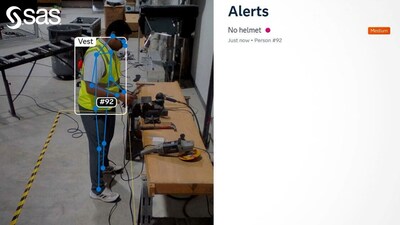
SAS Worker Safety enables organizations to address workplace risks using digital twins, synthetic data and computer vision. With this offering, customers use digital twins to create realistic footage for training computer vision models on workplace safety scenarios. This approach allows for virtually unlimited variation in simulated environments, capturing crucial details like the shape of protective eyewear, equipment color and how different lighting conditions can affect an accident.
Synthetic data and computer vision also make it possible to model rare, but plausible events for which real footage may not exist, like forklift collisions. By using fully simulated worker personas, organizations can repeatedly test specific sequences of actions without involving real employees or exposing any personally identifiable information.
Once trained, these models can be deployed across cameras within a facility to provide real‑time alerts, helping these facilities to ensure that workers are wearing protective equipment correctly and maintaining a safe environment. On a factory floor, this might mean verifying proper helmet positioning, or, in medical settings, detecting a slipped mask or glove before a lab or operating room is compromised.
SAS empowers state governments to help families in need
In administering Supplemental Nutrition Assistance Program (SNAP) benefits, states often struggle to keep pace with evolving regulation, heavy caseloads and managing time-consuming manual tech tasks. Now, new federal regulation can directly fine state budgets for exceeding the threshold for payment error rates: the percentage of benefits that are over- or under-awarded because of eligibility miscalculations, outdated case data or undetected fraud. These compounding errors can cost states millions in federal funding. And, most importantly, families who need vital assistance may not be receiving all the benefits they qualify for.
Multiple states, including the State of Nevada, are using SAS Payment Integrity for Food Assistance to confront this problem and better serve their constituents.
This SAS offering connects to a state's existing data – eligibility records, case management files, income verification data and transaction histories – without needing a total data infrastructure overhaul. Next, advanced analytics and machine learning models specifically trained for SNAP payment integrity can triangulate and track error patterns, like income or household changes that haven't triggered a case update.
This helps case workers and investigators already crunched for time. Instead of painstaking manual review, they can follow up on prioritized leads. And rather than a quarterly report, supervisors can plug into insights at any time from a live dashboard view of the program. With SAS, states can get ahead of the federal compliance curve and support families eligible for food assistance in getting the benefits they need.
SAS fuels fraud fighters across financial services
Per a recent fraud study by SAS and the Association of Certified Fraud Professionals, 75% of anti-fraud professionals are seeing a surge in financial fraud and scams targeting consumers, and 55% anticipate that deepfake social engineering and GenAI document fraud and forgery will increase significantly over the next two years.
Moreover, only 7% of surveyed anti-fraud professionals felt their organizations were more than moderately prepared to detect or prevent AI-fueled fraud.
Against this backdrop, global banks, insurers and other financial services organizations – and the fraud-fighting professionals they employ – trust SAS financial fraud detection models and agents to track financial crime and protect consumers' assets and identities. SAS Fraud Decisioning for Payments helps deliver real-time fraud detection across various financial transactions.
SAS' financial fraud detection models have been trained on patterns from a broad dataset contributed via consortium by major global financial institutions. This data spans credit card fraud, debit card fraud, ATM fraud, digital wallet fraud, application fraud and emerging vectors like money mule detection. SAS' fraud decisioning models, deployed on the SAS platform, mean institutions don't have to start from zero; they're learning from millions of fraud events across the industry, helping them keep pace with criminals.
Industry accelerators: Built to excel on 50 years of expertise
SAS industry accelerators are rigorously tested and uniquely designed for their designated functions. Plus, by integrating with an organization's existing workflows, industry players can use SAS' portfolio to extend their analytics and AI capabilities with their existing data.
"When organizations are left stitching together ad-hoc AI frameworks and experiments, they often fail to achieve the competitive edge they're looking for when they invest in AI," said Manisha Khanna, Global Market Strategy Lead, Applied AI at SAS. "We're engineering industry accelerators with purpose: to solve defined, real industry problems in highly regulated environments.
"With production-ready agents and models that work on data they already have, our customers across industries can and are achieving extraordinary outcomes."
Modeling the future at SAS Innovate
Today's announcement was made at SAS Innovate, the company's global data and AI conference, as SAS celebrates 50 years of innovation. This year's event is proudly supported by our partner sponsors, including Microsoft, Intel and AWS.
About SAS
SAS is a global leader in data and AI, helping organizations make confident decisions with AI they can trust. For decades, SAS has set the standard for delivering software that drives meaningful impact, incorporating deep industry expertise, transparency and governance. SAS gives you THE POWER TO KNOW®.
SAS and all other SAS Institute Inc. product or service names are registered trademarks or trademarks of SAS Institute Inc. in the USA and other countries. ® indicates USA registration. Other brand and product names are trademarks of their respective companies. Copyright © 2026 SAS Institute Inc. All rights reserved.
Editorial Contact:
Julia Norton
julia.norton@sas.com
919-531-4661
sas.com/news
 View original content to download multimedia:https://www.prnewswire.com/news-releases/sas-aims-ai-agents-at-industrys-toughest-challenges-302755075.html
SOURCE SAS
