DeepCura Unveils the Electronic Health Workforce (EHW) -- the Step Beyond the EHR
PR Newswire
WILMINGTON, Del., Aug. 24, 2026
Architected by founder Fern Cowan, the EHW is healthcare's system of evidenced action: a clinician-supervised AI workforce that does the practice's work on a finance-style ledger, where every action — and every entry in the chart — carries its receipt. It integrates with existing EHRs, or runs on its own.
WILMINGTON, Del., Aug. 24, 2026 /PRNewswire/ -- DeepCura Inc., the bootstrapped healthcare-AI company whose platform is used by more than 6,000 clinicians across the United States, today unveiled the Electronic Health Workforce (EHW) — a new class of clinical software designed to succeed the electronic health record. Systems of record store the practice's history. Systems of intelligence read it and advise. The EHW is the step beyond both — a system of evidenced action: a supervised workforce of AI receptionists, scribes, intake nurses, schedulers and inbox staff that does the practice's work and leaves a receipt for every step, with the clinician in command of every consequential decision.
The EHW is the culmination of three years of building DeepCura's platform and of a 2026 research and architecture program led by the company's founder, Fern Cowan, who designed the system's data model, its supervision doctrine and the product surfaces built on top of it.
The EHR was built to remember. The EHW is built to work.
For six decades the medical record has been optimized to remember — first on paper, then in the EHR — and to remember for someone else: a payer, a regulator, a plaintiff. The result is familiar to every clinician: charts that grow heavier with every visit, notes swollen by copy-and-paste, and a practice run across half a dozen disconnected systems — the EHR, the practice-management system, the CRM, the phone and fax lines, the population-health module, the inbox. Even the ambient AI scribes of the past three years, which taught the note to write itself, left the structured chart to be typed by hand.
"We stopped trying to polish the EHR and asked a different question: if the record could act, what would it look like?" said Cowan. "The EHR was built to remember. The EHW is built to work — a system of action with receipts, so the record it keeps of itself is one you can actually check."
Borrowed from finance — and from every industry that had to earn trust in its records
Rather than start from healthcare's conventions, Cowan researched how other high-stakes industries build records that can be trusted, and rebuilt DeepCura's foundation on those ideas:
- Ledger architecture, from finance. Every meaningful action in the practice — a call answered, a fact charted, a payment received, an appointment booked — becomes a permanent entry on one unified timeline. Nothing is edited in place; corrections are appended. Current state — the chart, the schedule, the balance, the dashboard — is derived from the ledger, the way a bank statement is derived from its transactions. The ledger keeps the accountant's distinction between when something happened and when it was recorded, every AI action carries its cost like a metered line item, and the audit trail becomes a property of the system rather than a feature bolted on afterward.
- Version control, from software engineering. The chart behaves like a code repository: each visit is a commit, and the clinician reviews a short diff of what changed — six deltas, not sixty pages — instead of re-reading the whole record. History is never overwritten.
- Credentialing, from hospitals — applied to machines. Every AI staff member is a named actor with a scoped set of privileges, working under supervision, with a permanent file of everything it did and why. Every AI action can be traced back to the conversation that caused it.
- One door, from cloud infrastructure. Every change of state passes through a single, governed path — and DeepCura runs its own company on the same workforce first: its AI agents handle the company's own sales calls, onboarding and configuration.
Concepts retired, systems consolidated
The EHW does not add another module to the practice's stack. It retires several categories of software and folds them into the ledger:
- Flowsheets became Ambient Trackables. A value spoken during the visit — "her A1c came back at 7.2" — becomes a coded, trendable data point with its evidence attached, on a longitudinal series the clinician can chart across years. Practices define any measure a specialty cares about — a depression score, pain by joint, units injected per site — without waiting for a standards body or buying a $10k enterprise module. Say it once. Tracked forever.
- Ambient documentation became Ambient Data. Ambient notes were step one. Ambient documentation is a note that writes itself; ambient data is a chart that fills itself. With Ambient Data, launched in July 2026, DeepCura became the first US system that turns conversations into population-level data — the chart writes itself, every value carries its evidence, and every entry is approved by the clinician.
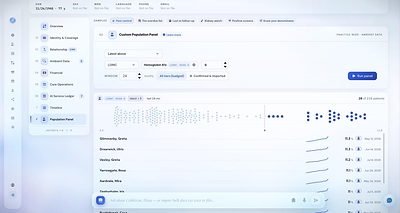
- The population-health module became native, custom Population Panels. Because chart data is coded and clinician-approved as it is captured, any practice can build a panel — every patient with a given condition and their latest values, care-gap lists exportable for outreach — in one click, from its own conversations. The country's largest EHR vendors typically sell these capabilities as separate premium modules, often priced at thousands of dollars a year; in DeepCura they are built into the chart at no additional cost.
- The inbox became an AI-staffed Inbox — and is evolving into Loops. Faxes, email, phone calls and text messages arrive in one queue where an AI staffer triages, drafts and clears work under a strict preview → confirm → execute contract. DeepCura is now evolving that inbox into Loops, which will open a loop for every standing obligation — a result not yet returned, a referral not yet answered, a follow-up promised out loud in the exam room — and watch it until it closes. An inbox shows what arrived; Loops will show what never did.
- Copy-and-paste became the receipt. Every fact in the DeepCura chart carries who entered or approved it, when, and where it came from — and AI-captured facts go further: the verbatim words that produced them, anchored to the exact second of the recording, or highlighted on the very page of the scanned fax or PDF they came from. Because each visit is recorded as a diff against the chart's memory, nothing needs to be carried forward from one note to the next. "A legacy EHR cannot show you where a line in the chart came from, because its data model has no place to put a receipt," Cowan said. "In the EHW, the receipt travels with the fact for the life of the record."
- CRM, practice management, communications and the clinical record became one timeline. A patient's whole story — every call, message, fax, payment, appointment, note and chart change, by human or AI — reads as one record shared by the practice's people and its AI staff. "What outreach led to this result?" is a single question, not a five-system reconciliation.
The EHW arrives on the back of a year in which DeepCura shipped Ambient Data, custom Population Panels, evidence-anchored charting, the AI-staffed Inbox, an in-house clinical terminology engine and an AI scheduling layer that mirrors EHR appointment books — all built and operated by a company that runs itself on its own AI workforce.
The safety ceiling is the product
Every AI action in the EHW is staged before it is real: AI proposes, the clinician disposes. An AI staffer can answer, book, draft and prepare on its own; every clinical fact it proposes waits for a clinician's approval, unverified AI-captured facts are labelled as such and never masquerade as clinician-verified truth, and every step it takes is on the record — permanently, and pointing back to the conversation that caused it.
"Healthcare does not need AI that acts unsupervised. It needs AI whose supervision is structural," Cowan said. "In the EHW the constraint is the product: nothing irreversible reaches a patient's chart without a human's hand, and everything the workforce does can be audited to the word."
Not against the EHR
DeepCura built the EHW in a collaborative spirit. It connects natively to leading EHRs — including Epic, athenahealth, eClinicalWorks and AdvancedMD — pushing finished notes directly into patient charts and syncing appointments and demographics; and it can run on its own as the practice's primary working system for practices that do not want a legacy EHR at all.
"Your EHR keeps the record; the EHW does the work," Cowan said. "Practices don't have to choose. They keep what they have, add the workforce, and let the memory compound — visit by visit, the tab that opens first every morning changes on its own."
Availability
The Electronic Health Workforce is available today at www.deepcura.com, priced from $129 per provider per month, with EHR integration included in every plan and a free trial. DeepCura is HIPAA compliant and CASA certified, and is rated 4.6/5 on G2.
The consolidation carries a price story of its own: every system the EHW retires is a line item that disappears. DeepCura estimates that practices replacing their full stack — the scribe subscription, the answering service, the CRM, the population-health module, the fax service, the intake tool — spend up to 10× less on software alone, and beyond the subscription, AI work is metered as usage-based credits, so practices pay for the work they actually use rather than a seat license for every tool in the pile.
About DeepCura
DeepCura Inc. is the Electronic Health Workforce: a supervised AI receptionist, scribe, intake nurse, scheduler and inbox that does a practice's work while the record keeps itself. Bootstrapped and growing since 2023 and based in Wilmington, Delaware, DeepCura is profitable, has never taken outside funding, and is used by more than 6,000 clinicians who have generated more than one million clinical encounters on the platform. Learn more at www.deepcura.com.
About Fern Cowan
Fern Cowan is the founder and architect of DeepCura and the researcher behind the Electronic Health Workforce. A Mexican-born technologist, he spent seven years in San Francisco, where his previous venture, Cowan Agency, served some of Silicon Valley's top technology companies, before moving to Poland in pursuit of its engineering talent and innovation culture — the base from which he now leads DeepCura's research and architecture. He designed and built DeepCura's platform — its backend, frontend, AI agents and infrastructure — and authored the EHW's ledger-based data model and its supervision doctrine. He is a member of the Forbes Business Council. His thesis, which DeepCura exists to prove, is that the era of scaling companies with headcount is over: a single founder with the right AI workforce can build and operate what once required dozens of engineers and tens of millions of dollars in venture capital — and that the same is now true of a medical practice.
Notes to editors — glossary
- Electronic Health Workforce (EHW): the class of software that succeeds the EHR — a supervised AI workforce that does a practice's work and records itself as it goes; a system of evidenced action.
- System of evidenced action: the EHW's category — beyond the system of record (stores) and the system of intelligence (advises), a workforce that acts, and whose every action carries its evidence: who, when, why, and, for AI-captured facts, the verbatim words at the exact second of the recording.
- The ledger: the EHW's permanent, append-only timeline of every meaningful action, by human or AI, from which the current chart, schedule and dashboards are derived.
- Ambient Data: the evolution of ambient documentation — the chart that fills itself from the clinical conversation, with evidence attached and every entry clinician-approved.
- Ambient Trackables: DeepCura's replacement for the flowsheet — any measure a practice defines, captured from the visit and tracked as a longitudinal series.
- Population Panels: one-click, custom panels and care-gap lists built from the practice's own clinician-approved chart data.
- Loops: the successor to the inbox, now in development — a loop opened for every standing obligation and watched until it closes.
- The receipt: the provenance carried by every fact in the chart — who, when, and where it came from; for AI-captured facts, the verbatim words and the exact second of the recording.

 View original content to download multimedia:https://www.prnewswire.com/news-releases/deepcura-unveils-the-electronic-health-workforce-ehw--the-step-beyond-the-ehr-302858389.html
SOURCE DeepCura Inc
