Mead, Oxford , July 20, 2026 (GLOBE NEWSWIRE) -- As artifficial intelligence moves from boardroom priority to operational reality, CoreFiling is making the case that organisations are only solving half the problem. The race to build smarter AI applications, it argues, is obscuring a more fundamental challenge: the quality, structure and governance of the data those applications depend on.
The AI landscape in 2026 is crowded with application-layer innovation. New tools, interfaces and AI-generated front ends are emerging at a pace that would have seemed implausible just a few years ago. Code generation has made it easier than ever to build capable-looking applications for almost any purpose, and the barrier to entry for AI deployment has never been lower. But beneath the surface of this activity, a quieter and more consequential competition is playing out, one that will ultimately determine which AI projects deliver lasting value and which ones quietly fail.
That competition is happening at the data layer.
The Application Layer is Being Commoditised
The ability to build an AI-powered application is no longer a meaningful differentiator. As code generation tools become more sophisticated and accessible, the application layer is rapidly becoming a commodity. What an AI system can do becomes less important than what it knows, how accurately it can retrieve it, and how confidently it can be trusted to act on it.
This shift has significant implications for organisations making long-term infrastructure decisions. Investing primarily in application-layer capability, without equivalent attention to the data foundation beneath it, is a strategy that may deliver short-term results but will struggle to scale. The organisations that will extract sustainable value from AI are those that have invested in making their data richly structured, well governed and easily accessible to automated systems.
Hallucinations or Bad Data?
One of the most discussed risks in enterprise AI deployment is hallucination, where an AI system generates plausible-sounding but inaccurate outputs. It is widely understood that hallucinations are damaging in consumer applications. In regulated industries, they are potentially catastrophic.
What is less widely understood is that many AI reliability issues originate in the data layer rather than the model itself. When information used by AI agents is poor quality, even highly capable models can produce unreliable outputs.
The answer to this problem lies in ensuring that data made available to AI is not only accurate but easily and precisely retrievable. CoreFiling's approach to highly structured, richly defined data, built on deep expertise in standards including XBRL and iXBRL, is designed to give AI systems exactly that kind of reliable foundation, one where the meaning of a data point is as clear as its value.
Governance is Not Optional
Alongside data quality, governance is the other dimension that separates AI projects that scale from those that stall. Organisations need to be able to control and define which data is made available to AI systems, ensuring that automated processes are working with approved, validated information rather than drawing on uncontrolled or inconsistent sources.
This is particularly acute in regulated industries, where the provenance and accuracy of data is not just a quality concern but a compliance one. CoreFiling's platform provides the governance infrastructure that allows organisations to define, control and audit the data made available to AI, ensuring that outputs are explainable and defensible. Further to this, when data is derived, the lineage of this calculated data can be traced back to the report or publication as a direct source that can be cited and examined for further investigation.
For organisations whose external reporting and digital assurance obligations are growing in complexity, AI-focussed data governance is a strategic necessity.
The Case for Connected Data
CoreFiling
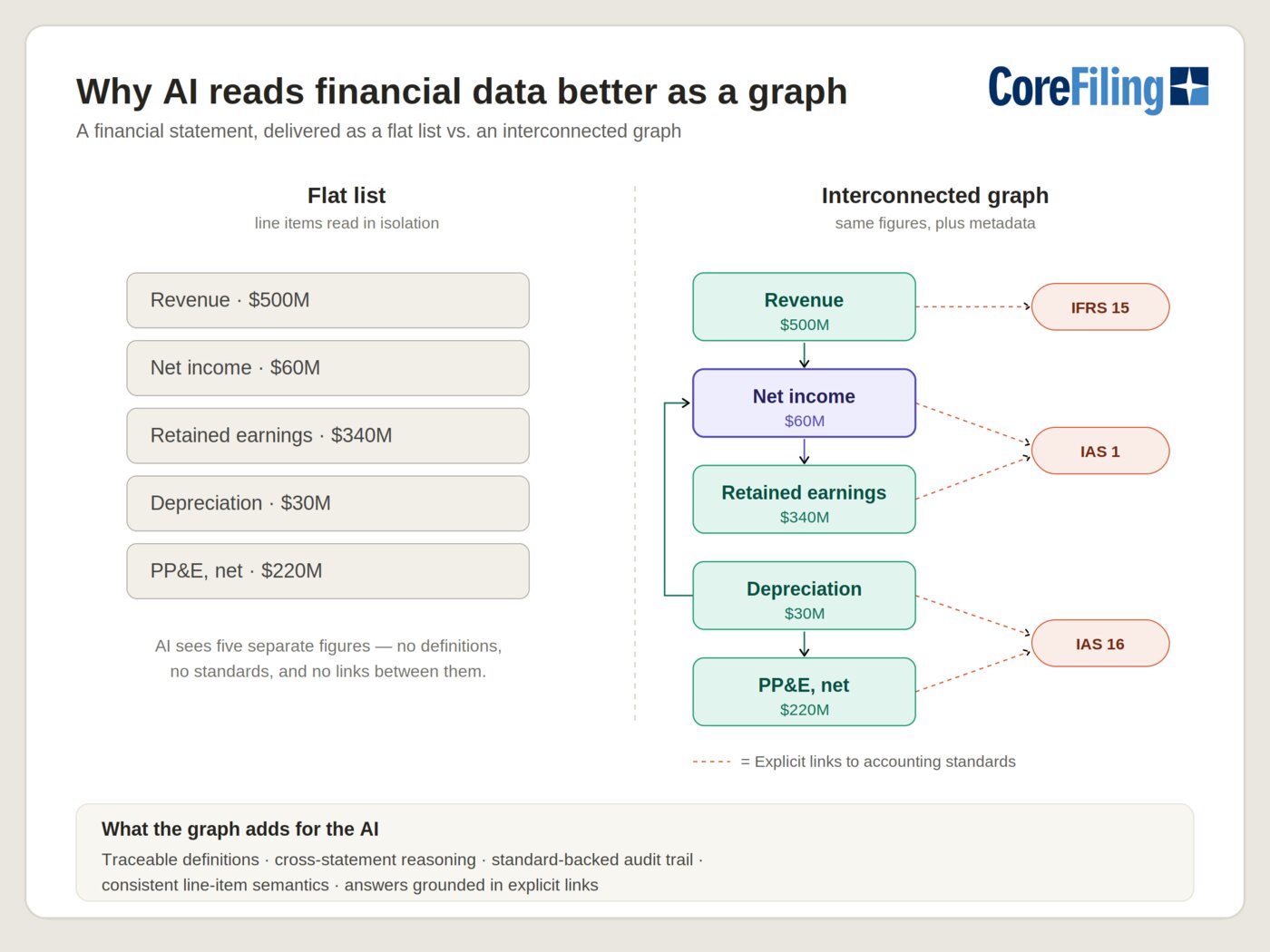
Perhaps the most important and least discussed dimension of AI-ready data infrastructure is the structure of the data that is stored. The taxonomies that accompany digital business data allow for more than just a list of values in a database. They represent an entire knowledge graph that captures not just what a data point is, but how it relates to the other data around it.
AI systems that operate over connected, semantically rich data are fundamentally more capable than those reasoning over flat or fragmented datasets. They can navigate relationships, surface context and produce outputs that are not just accurate but explainable, a quality that is becoming non-negotiable in governance-sensitive environments.
CoreFiling's long-standing expertise in data modelling and structured standards positions it to help organisations move beyond data storage toward genuinely connected data infrastructure. This works to get the best out of AI by giving it the data structures it natively uses and enables the reasoning that makes AI so impressive and useful.
The Strategic Opportunity
The organisations that will lead in AI are not necessarily those with the most sophisticated applications. They will be the ones that have done the harder, less glamorous work of getting their data right. As the application layer continues to commoditise, the data layer will increasingly be where competitive advantage is won or lost.
Standards, structure and governance create the conditions to make AI trustworthy. Richly defined, interconnected graphs of data, such as that described in XBRL taxonomies unlock advanced reasoning in AIs. CoreFiling has spent nearly three decades building exactly this kind of rich and trusted data infrastructure across regulatory jurisdictions worldwide. As AI scales, this foundation is not just relevant but essential.
To learn more about CoreFiling and its approach to structured data infrastructure, visit www.corefiling.com.
###
Media Contact
CoreFiling
Osney Mead House, Osney Mead, Oxford, OX2 0FA
sales@corefiling.com