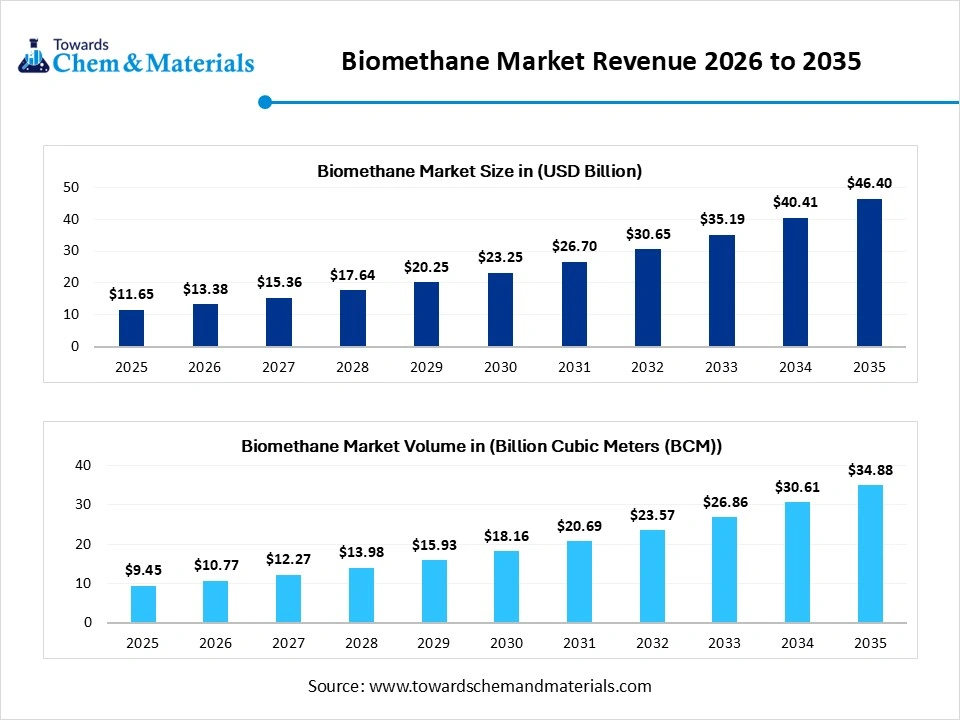
Ottawa, April 24, 2026 (GLOBE NEWSWIRE) -- The global biomethane market was valued at USD 11.65 billion in 2025, is estimated to reach USD 13.38 billion in 2026, and is projected to reach USD 46.40 billion by 2035, growing at a CAGR of 14.82% from 2026 to 2035. In terms of volume, the biomethane market is projected to grow from 9.45 million tons in 2025 to 34.88 million tons by 2035. growing at a CAGR of 13.95% from 2026 to 2035. Europe dominated the biomethane market with the largest revenue share of 35% in 2025. Incorporation of stricter government regulations, focus on sorting exceeding municipal waste & a pivotal aim at decarbonization, drives the global market growth. A study published by Towards Chemical and Materials a sister firm of Precedence Research.
Don’t miss out on business opportunities in Biomethane Market. Speak to our analyst and gain crucial industry insights that will help your business grow. {Download a Sample Report Here@ https://www.towardschemandmaterials.com/download-sample/5619}
Download a Sample Report Here@ https://www.towardschemandmaterials.com/download-sample/5619
Biomethane Market Report Highlights
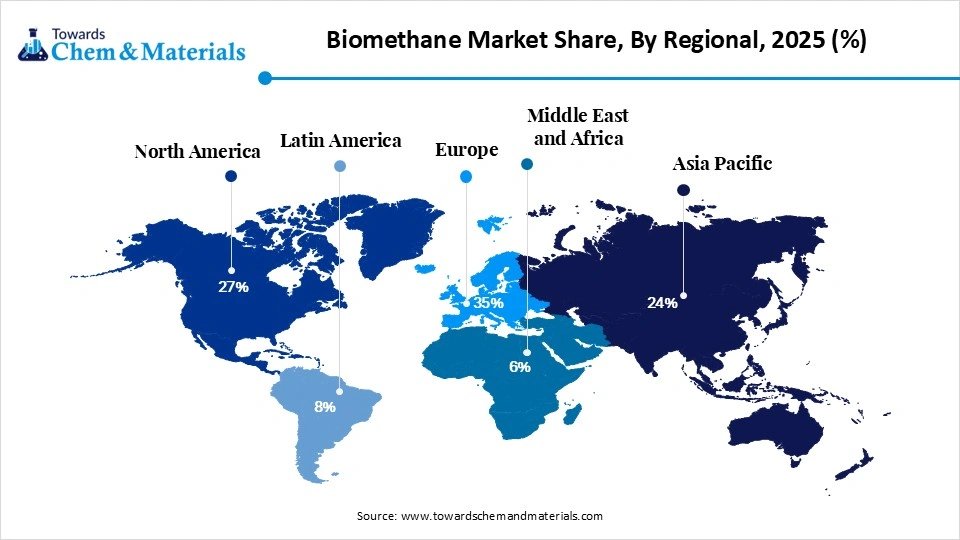
- By region, Europe dominated the market with a share of 35% in 2025.
- By region, Asia Pacific held the market share of 24% in 2025 and is expected to sustain its position while growing with a CAGR of 16.2% in the forecast period.
- By feedstock, the agriculture segment dominated the market with 38% share in 2025 and is expected to have the fastest growth with a CAGR of 15.20% in the forecast period.
- By production technology, the anaerobic digestion segment dominated the market with 72% share in 2025.
- By production technology, the gasification segment held 18% market share in 2025 and is expected to have the fastest growth with a CAGR of 15.8% in the forecast period.
- By application, the power generation segment is experiencing growth in 2025.
- By application, the transportation fuel segment is experiencing growth in 2025.
- By end-use industry, the utilities segment dominated the market with 34% share in 2025.
- By end-use industry, the transportation segment held 22% market share in 2025 and is expected to have the fastest growth with a CAGR of 16.8% in the forecast period.
- By distribution channel, the grid injection segment dominated the market with 46% share in 2025 and is expected to have the fastest growth with a CAGR of 14.9% in the forecast period.
Market Size and Volume Forecast
- Market Estimated Size (2026): USD 13.38 Billion | CAGR (2026–2035): 14.25%
- Market Projected Size (2035): USD 46.40 Billion
- Market Volume (2025): 9.45 Billion Cubic Meters (BCM) | Volume CAGR (2026–2035): 13.95%
- Market Projected Volume (2035): 34.88 Billion Cubic Meters (BCM)
- Market Pricing (2025):
- Average Manufacturing Price: USD 0.48/Nm³
- Average Selling Price: USD 0.75/Nm³
- Pricing CAGR (2025–2035): 3.8%
Request Research Report Built Around Your Goals: sales@towardschemandmaterials.com
Why is the Biomethane Market Progressing?
The global adoption of a renewable, near-pure form of methane developed by advancing biogas derived from organic waste, like manure, sewage sludge, or food scraps via anaerobic digestion, is defined as biomethane. The overall market expansion is propelled by the continuous execution of initiatives by governments for renewable natural gas (RNG) to fulfil decarbonization goals. Another catalyst is that surging urbanisation generates massive municipal solid waste, which is further converted into biogas.
Pivotal Role in Decarbonization & Circular Economy: Major Potentials
Very firstly, the biomethane market is promoted as a low-carbon or carbon-neutral energy source. The market encompasses biomethane sourced from waste & integrated with carbon capture methods, offering negative emissions. Alongside, agricultural waste, manure, & sewage sludge are converted into valuable energy, which prevents methane emissions from waste storage & develops digestate for eco-friendly biofertilizer.
What are the Substantial Limitations of the Biomethane Market?
The development of biomethane projects is quite expensive, which generally requires 3 to 5 times higher than natural gas, & also demands rigorous government assistance. Preservation of a persistent, reliable supply of organic feedstock is a complex one, with logistics & sourcing creating operational barriers.
Immersive Funding in the Biomethane Market (2025-2026)
| Bionext Infrastructure (April 2026) | Secured a €113 million financing package to fund the transition of its existing assets into 100% renewable biomethane production facilities & assist the prospective expansion. |
| European Commission (April 2026) | Approved a €3.7bn ($4.36bn) Czech government funding scheme to boost sustainable biomethane production, surrounded by the net-zero emission promotion. |
| Australian developer Optimal Renewable Gas (ORG) (February 2026) | Received a $20 million government grant to foster construction of the Griffith Biohub, a $58 million project that will turn agricultural waste from New South Wales's Riverina region into renewable biomethane. |
| Brazilian Development Bank (BNDES) (February 2026) | Approved & contracted financing of R$148.5 million for Bioo Paraná Holding SA to establish a biomethane plant in Toledo, in western Paraná. |
| Solomon Islands (December 2025) | Secured USD1.58 million for the SENBIOSIS Project, to escalate access to clean & renewable energy in rural areas of the Solomon Islands by installing biogas plants. |
| German Export Finance Bank (August 2025) | Extended €38 million in equity and debt funding to CEF Group, an Indian company emphasizes the conversion of waste into compressed biogas. |
Uses and applications of biomethane
Biomethane has properties and energy content very close to conventional natural gas, which allows it to be used in many of the same ways across different sectors. Its versatility makes it an important renewable energy source in the transition toward cleaner systems. Biomethane can serve as a direct substitute for natural gas by being injected into existing gas distribution networks. It can be blended in any proportion and supplied for residential, commercial, and industrial use, enabling efficient utilization of current infrastructure without major modifications. It is also widely used for energy generation. Through combustion, biomethane (or even untreated biogas) can produce electricity and heat, making it suitable for combined heat and power (CHP) systems and decentralized energy production.
In the transportation sector, biomethane functions as a renewable fuel alternative. When used in compressed natural gas (CNG) vehicles, it significantly reduces greenhouse gas emissions and improves air quality. This is particularly evident in public transportation systems, such as urban bus fleets, where adoption is steadily increasing. Another important application is its role as a feedstock in industrial processes. Biomethane can be utilized to produce renewable hydrogen, contributing to the development of clean energy technologies and supporting decarbonization efforts.
Beyond energy uses, biomethane production also delivers socio-economic benefits. It supports rural development by creating employment opportunities, especially in agriculture and livestock-related activities. Additionally, on-site energy generation helps farms lower emissions and improve sustainability. Biomethane plays a key role in advancing the circular economy. It enables the effective conversion of organic waste into energy, while the by-product, known as digestate, can be reused as a nutrient-rich fertilizer, returning valuable resources back to the soil.
Biomethane Market: Regional Analysis
The Europe biomethane market size was estimated at USD 4.08 billion in 2025 and is projected to reach USD 16.47 billion by 2035, growing at a CAGR of 14.97% from 2026 to 2035
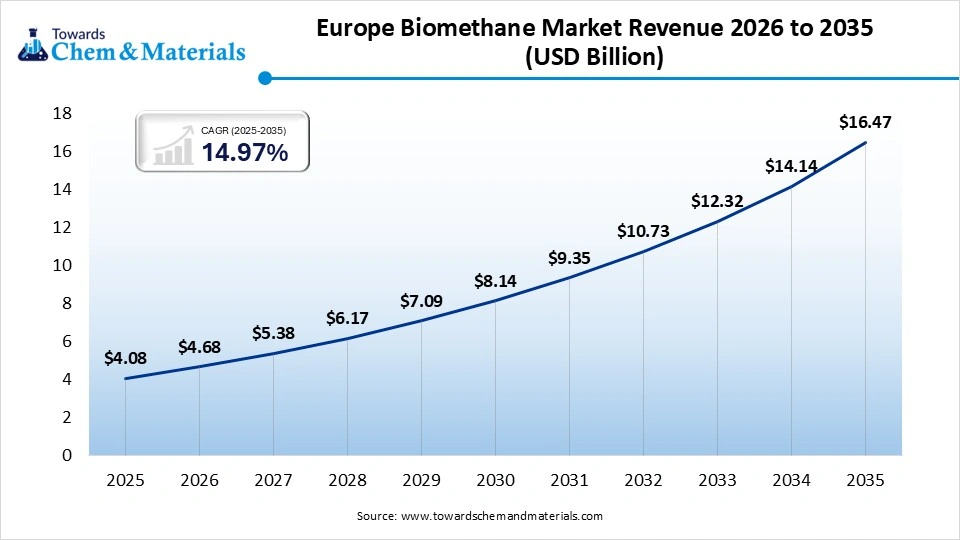
Europe dominated with a major share of the market in 2025. The dominance is driven by the Renewable Energy Directive (RED III) & the Fit for 55 package, which develops a robust regulatory landscape & fosters decarbonization in transport & industry. Surging need to substitute Russian natural gas has pushed investment in domestic renewable gas production, which further speeds up projects in France, Germany, & developing markets, such as Spain.
For instance,
- In January 2026, Asterion Industrial Partners invested €1.5 billion in its European biomethane platform, ABIO (Asterion Bioenergy), emphasizing the evolution of a key pan-European player in renewable gas.
However, the UK’s biomethane market has been leading, due to the UK government's Clean Flexibility Roadmap. This has encouraged the injection of biomethane for peak energy demand. Moreover, the National Energy System Operator (NESO) scenarios cover 65TWh of biomethane by 2050, a robust signal for progression.
North America Market Analysis
North America is estimated to expand fastest in the market during 2026-2035. This expansion is spurred by the enforcement of the U.S. Renewable Fuel Standard (RFS) & California’s Low Carbon Fuel Standard (LCFS), which generate high-value encouragements, making biomethane appealing as a transportation fuel. Specifically, California, Texas, & Wisconsin are leveraging landfills, dairy farms, & wastewater treatment plants as the primary sources of feedstock.
For instance,
- In March 2026, Kanadevia Inova announced the official innovation of the Louisville Township Renewable Gas Project, a groundbreaking large-scale anaerobic digestion facility located in Louisville Township, Minnesota.
In Canada, British Columbia & Quebec are progressing with regulations that require natural gas suppliers to comprise a particular percentage of renewable gas (RNG) in their mix. Besides this, the Canadian government is highly emphasizing policies that compensate landfill & farm projects for recording methane emissions, focusing on net-zero emissions by 2050.
Immediate Delivery Available | Buy This Premium Research Report (Global Deep Dive
USD 3200) https://www.towardschemandmaterials.com/checkout/5619
Biomethane Market Report Scope
| Report Attribute | Details |
| Market Size and Volume in 2026 | USD 13.38 Billion / 10.77 million Metric Tons |
| Market Size and Volume in 2026 | USD 46.4 Billion / 34.88 million Metric Tons |
| Growth rate | CAGR of 14.82% from 2026 to 2035 |
| Base year for estimation | 2025 |
| Historical data | 2021 - 2025 |
| Forecast period | 2026 - 2035 |
| Quantitative Units | Revenue in USD million/billion and CAGR from 2025 to 2035 |
| Report coverage | Revenue forecast, competitive landscape, growth factors, and trends |
| Segments covered | By Feedstock, By Production Technology, By Application, By End-Use Industry, By Distribution Channel and By Region |
| Regional scope | North America; Europe; Asia Pacific; Latin America; Middle East & Africa |
| Country scope | U.S.; Canada; Mexico; Germany; France; Italy; Denmark; Netherlands; China; India; Japan; South Korea; Brazil; Argentina; South Africa; Saudi Arabia. |
| Key companies profiled | Air Liquide; Engie; Nature Energy Biogas A/S; Gasum; Terega Solutions; Waga Energy; TotalEnergies; Chevron; Kinder Morgan; Archea Energy; Envitec Biogas AG; Future Biogas Ltd.; E.ON SE; Verbio Vereinigte Bioenergie AG; South Hills RNG |
Immediate Delivery Available | Buy This Premium Research Report@https://www.towardschemandmaterials.com/download-sample/5619
Biomethane Market Segmentation Insights
Feedstock Insights
The Agricultural Waste Segment Dominated The Market With 38% Market Share In 2025
The agricultural waste segment dominated the market with 38% shares in 2025 and is expected to have the fastest growth with a CAGR of 15.20% in the forecast period, driven by the need for sustainable waste management, high methane yields from manure and crop residues, and strong government incentives to boost renewable energy. This segment allows farmers to reduce emissions while creating extra income streams. The decentralized nature of these sources promotes the establishment of small-to-medium-scale biogas facilities in rural areas, strengthening local energy security.
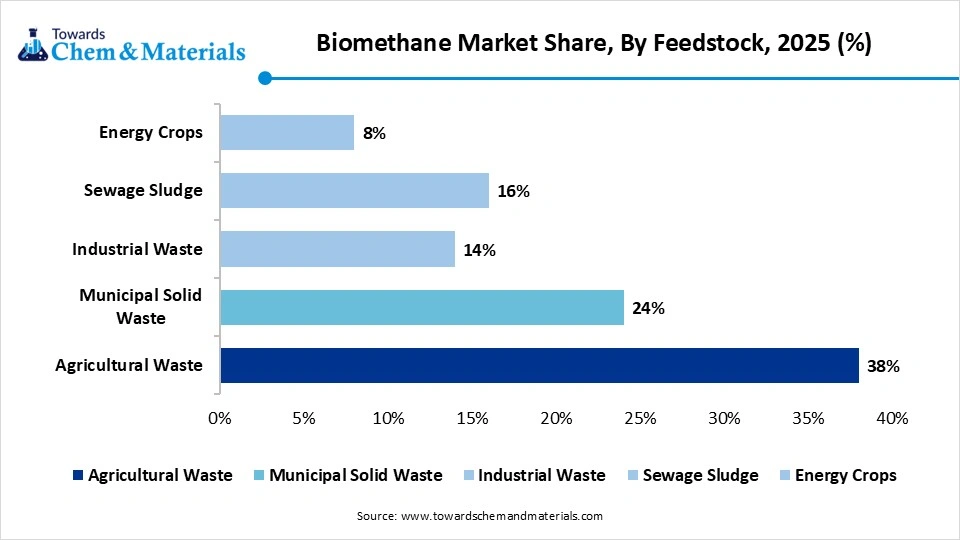
The municipal solid waste segment held 24% market share in 2025, driven by the urgent need to manage rising urban waste volumes, strict landfill diversion regulations, and the shift toward circular economy models significant investments from governments and private firms are accelerating the deployment of waste-to-energy projects, treating food waste, garden waste, and biodegradable packaging. MSW-based biomethane helps cities achieve net-zero targets by treating organic waste and preventing methane leakage from landfills.
The sewage sludge segment held 16% market share in 2025, driven by its high potential to produce renewable natural gas (RNG) through anaerobic digestion. tightening environmental regulations, the need for sustainable waste management in growing cities, and advanced upgrading technologies that allow utilities to turn wastewater residues into high-value energy are the key growth drivers which supports growth of the market.
The industrial waste segment held 14% market share in 2025, driven by the need for cost-effective waste management, strict environmental regulations on wastewater, and the high energy potential of industrial food waste. This segment is increasingly utilized to create renewable natural gas (RNG), allowing industries to cut disposal costs while meeting sustainability goals.
Production Technology Insights
The Anaerobic Digestion Segment Dominated the Market With 72% Market Share In 2025
The anaerobic digestion segment dominated the market with 72% share in 2025, driven by its cost-effectiveness, ability to process diverse organic waste, and strong government subsidies for waste-to-energy projects in regions. AD solves two problems at once, converting organic waste (sludge, manure, food waste) into renewable fuel while creating, in some cases, nutrient-rich digestate for fertilizer. AD is a more mature and lower-cost technology, making it ideal for immediate, widespread deployment.
The gasification segment held 18% market share in 2025 and is expected to have the fastest growth with a CAGR of 15.8% in the forecast period, it enables the conversion of dry, woody, and lingo-cellulosic feedstocks like forestry residues, industrial waste into high-quality syngas, which biological processes cannot easily digest. This versatility significantly broadens the feedstock base beyond conventional agricultural waste. Increasing investment in advanced WTE systems and strict regulations against landfilling are pushing for technology that converts waste into high-value fuel. Innovations in gasification technology have boosted syngas yield and quality, lowering operational risks.
The Power-to-Gas segment held 10% market share in 2025 by chemically upgrading biogas into higher-purity biomethane using renewable hydrogen, thereby increasing total output. This approach addresses demand for decarbonization, provides long-term energy storage, and helps meet strict environmental regulations. PtG helps meet global net-zero emissions targets by 2050. The resulting biomethane is a sustainable, low-carbon alternative to fossil fuels that can be injected into existing natural gas pipelines.
Application Insights
The Power Generation Segment Is Experiencing Growth In 2025
The power generation segment is experiencing growth in 2025, driven by the need for dispatchable renewable electricity, decarbonization goals, and high compatibility with existing natural gas infrastructure. It is a dominant application due to rising demand for clean energy in residential and commercial sectors, including heating and cooking, as well as upgrading old biogas plants for higher efficiency.
The transportation fuel segment experiencing growth in 2025, driven by the need for low-carbon alternatives to diesel in heavy-duty vehicles, strong policy incentives (such as EU's RED II and Renewable Natural Gas mandates), and its compatibility with existing Compressed Natural Gas (CNG) and Liquefied Natural Gas (LNG) infrastructure. It is expanding due to high-volume use in logistics and public transit.
The heating segment experiencing growth in 2025, driven by its role as a "drop-in" substitute for natural gas in existing infrastructure, strong policy support for decarbonization (e.g., REPowerEU), and rising demand for renewable residential, commercial, and industrial heating solutions.
The industrial use experiencing growth in 2025, driven by the urgent need for cost-effective decarbonization in hard-to-abate sectors like high-temperature heating, chemicals, and manufacturing. Industries are adopting biomethane as a direct, drop-in replacement for natural gas to cut Scope 1 emissions without changing existing machinery.
End-Use Industry Insights
The Utilities Segment Dominated The Market With 34% Market Share In 2025
The utilities segment dominated the market with 34% share in 2025, driven by the need to decarbonize gas grids, meet renewable energy mandates, and achieve energy security by substituting imported natural gas with renewable alternatives. Utilities are increasingly acting as both investors in production plants and key off-takers, injecting, or feeding, purified biomethane directly into existing pipelines.
The transportation segment held 22% market share in 2025 and is expected to have the fastest growth with a CAGR of 16.8% in the forecast period, driven by the urgent need to decarbonize heavy-duty logistics and public transport through cost-effective, drop-in alternatives to diesel. Biomethane acts as a "drop-in" fuel, utilizing existing natural gas vehicle (CNG/LNG) fleets and filling station infrastructure, avoiding high costs associated with converting vehicles.
The industrial segment held 18% market share in 2025, by acting as a key solution for decarbonizing high-temperature heating, chemicals, and manufacturing processes. Driven by carbon regulations and the need to replace natural gas, industrial users are increasingly adopting biomethane. The industrial segment is utilizing its own organic waste including sewage sludge, wastewater, and agricultural byproducts to produce on-site, cost-effective energy.
The residential segment held 14% market share in 2025, driven by the urgent need to decarbonize residential heating and cooking, supported by expanding grid injection infrastructure, and rising consumer demand for renewable energy sources. Governments are implementing policies that encourage replacing natural gas with biomethane in residential buildings to meet emissions reduction targets.
Distribution Channel Insights
The Grid Injection Segment Dominated The Market With 46% Market Share In 2025
The grid injection segment dominated the market with 46% share in 2025 and is expected to have the fastest growth with a CAGR of 14.9% in the forecast period, by enabling the direct, large-scale injection of upgraded biogas into existing natural gas infrastructure. Injecting biomethane into existing networks allows for the use of current infrastructure for renewable gas distribution, reducing reliance on imported fossil gas.
The on-site consumption segment held 32% market share in 2025, driven by the demand for localized, reliable, and low-carbon energy in agriculture and industry, with on-site direct usage. Upgraded biomethane (Bio-CNG) is directly fueling municipal fleets, waste trucks, and agricultural machinery, offering a cleaner alternative to diesel. On-site production enables companies to create their own secure, sustainable, and reliable source of energy, mitigating dependency on imported fossil fuels.
The bottled/compressed gas supply segment held 22% market share in 2025, driven by its role as a drop-in, cleaner substitute for fossil fuels in transportation and industry. This growth is propelled by its ability to be transported easily to areas lacking natural gas grid infrastructure, its use in heavy-duty vehicles, and increasing government incentives. Strong government support, such as India's SATAT initiative, is fueling the construction of hundreds of CBG plants to produce and bottle bio-CNG, creating a significant, localized market.
More Insights in Towards Chemical and Materials:
- Hydrophilic Coatings Market Size to Surpass USD 32.99 Bn by 2035
- Lithium-Ion Battery Solvent Market Size to Hit USD 24.72 Bn by 2035
- U.S. Liquefied Natural Gas Market Size to Surpass USD 185.92 Bn by 2035
- Polypropylene Yarn Market Size to Reach USD 34.01 Billion by 2035
- U.S Natural Gas Storage Market Size to Hit USD 37.59 Bn by 2035
- U.S. Sustainable Aviation Fuel Market Size to Hit USD 64.01 Bn by 2035
- Liquefied Natural Gas Market Size to Hit USD 291.67 Billion by 2035
- Lithium-ion Battery Market Size to Reach USD 416.96 Billion by 2035
- Steel Plate Market Size to Hit USD 365.84 Billion by 2035
- Zero-waste Construction Materials Market Size to Surpass USD 244.20 Bn by 2035
- Asia Pacific Liquefied Natural Gas Market Size to Hit USD 281.63 Billion by 2035
- Carbon Fiber (CF) And Carbon Fiber Reinforced Plastic (CFRP) Market Size to Surpass USD 6.65 Billion by 2035
- Ethylene Carbonate Market Size to Reach USD 6.65 Billion by 2035
- U.S. Natural Gas Market Size to Hit USD 669.70 Billion by 2035
- Sodium Lauryl Ether Sulfate Market Size to Surpass USD 7.00 Billion by 2035
- Fumed Silica Market Size to Surpass USD 5.03 Billion by 2035
- Ductless HVAC Systems Market Size to Hit USD 183.15 Billion by 2035
- Construction Adhesives Market Size to Hit USD 18.44 Billion by 2035
- Formamide Market Size to Hit USD 2.99 Billion by 2035
- Oxidizing Agents Market Size to Hit USD 12.11 Billion by 2035
- Post-Consumer Recycled Plastics Market Size to Hit USD 38.10 Billion by 2035
- High Purity Methane Gas Market Size to Reach USD 15.40 Billion by 2035
- Europe Powder Coatings Market Size to Reach USD 6.54 Billion by 2035
- Asia Pacific Powder Coatings Market Size to Surpass USD 20.42 Billion by 2035
- Polyurethane Dispersion Market Size to Surpass USD 8.12 Billion by 2035
- Polyhydroxyalkanoates (PHA) Market Size to Hit USD 4,045.64 Million by 2035
- Electronic Hydrofluoric Acid Market Size to Surpass USD 3.48 Billion by 2035
- Base Oil Market Size to Reach USD 54.69 Billion by 2035
- Aniline Market Size to Surpass USD 18.62 Billion by 2035
- Mold Release Agent Market Size to Hit USD 5.36 Billion by 2035
- Marine Lubricants Market Size to Reach USD 13.94 Billion by 2035
- Isocyanates Market Size to Surpass USD 51.11 Billion by 2035
- Grafted Polyolefins Market Size to Hit USD 8.28 Billion by 2035
- Acrylonitrile Market Size to Hit USD 18.97 Billion by 2035
Biomethane Market Top Key Companies:
- Air Liquide
- Engie
- Nature Energy Biogas A/S
- Gasum
- Terega Solutions
- Waga Energy
- TotalEnergies
- Chevron
- Kinder Morgan
- Archea Energy
- Envitec Biogas AG
- Future Biogas Ltd.
- E.ON SE
- Verbio Vereinigte Bioenergie AG
- South Hills RNG
Recent Developments
- In April 2026, EnviTec Biogas started feed-in from a 417 Nm³/h EnviThan gas upgrading plant, marking its second successfully settled biomethane project in Slovakia.
- In April 2026, France-based Sublime Energie (Sublime) rolled out the world’s first system, which can liquefy biogas directly on a farm.
- In February 2026, Egypt inaugurated its first biogas unit to transition slaughterhouse waste into renewable energy & organic fertiliser, with a focus on reinforcing the country’s green economy & minimizing environmental impact.
- In November 2025, Copenhagen Infrastructure Partners (CIP) formally initiated the construction of Finland’s giant biogas plant, which develops greater than 200 GWh of liquefied biomethane & processes 600,000 tonnes of biomass each year.
Biomethane Market Report Segmentation
This report forecasts revenue growth at global, regional, and country levels and provides an analysis of the latest industry trends in each of the sub-segments from 2019 to 2035. For this study, Towards Chemical and Materials has segmented the global Biomethane Market
By Feedstock
- Agricultural Waste
- Crop Residues
- Animal Manure
- Municipal Solid Waste (MSW)
- Organic Household Waste
- Commercial Waste
- Industrial Waste
- Food Processing Waste
- Pulp & Paper Waste
- Sewage Sludge
- Wastewater Treatment Plants
- Industrial Sludge
- Energy Crops
- Maize Silage
- Grass Silage
By Production Technology
- Anaerobic Digestion (AD)
- Wet AD
- Dry AD
- Gasification
- Thermal Gasification
- Plasma Gasification
- Power-to-Gas
- Biological Methanation
- Catalytic Methanation
By Application
- Power Generation
- CHP (Combined Heat & Power)
- Electricity Generation
- Transportation Fuel
- Compressed Biomethane (Bio-CNG)
- Liquefied Biomethane (Bio-LNG)
- Heating
- Residential Heating
- District Heating
- Industrial Use
- Process Heat
- Steam Generation
By End-Use Industry
- Utilities
- Transportation
- Industrial
- Residential
- Commercial
By Distribution Channel
- Grid Injection
- On-site Consumption
- Bottled/Compressed Gas Supply
By Regional
- North America
- Europe
- Asia Pacific
- Latin America
- Middle East & Africa
Immediate Delivery Available | Buy This Premium Research Report@
https://www.towardschemandmaterials.com/checkout/5619
About Us
Towards Chemical and Materials is a leading global consulting firm specializing in providing comprehensive and strategic research solutions across the chemical and materials industries. With a highly skilled and experienced consultant team, we offer a wide range of services designed to empower businesses with valuable insights and actionable recommendations.
To find out more, visit www. Towards Chemicals and Materials Analytics and Consulting ™.com or follow us on Twitter, LinkedIn
Contact:
Towards Chemicals and Materials Analytics and Consulting
USA: +1 804 441 9344
APAC: +61 485 981 310 or +91 87933 22019
Europe: +44 7383 092 044
Email: sales@towardschemandmaterials.com
Visit Our Website: https://www.towardschemandmaterials.com/